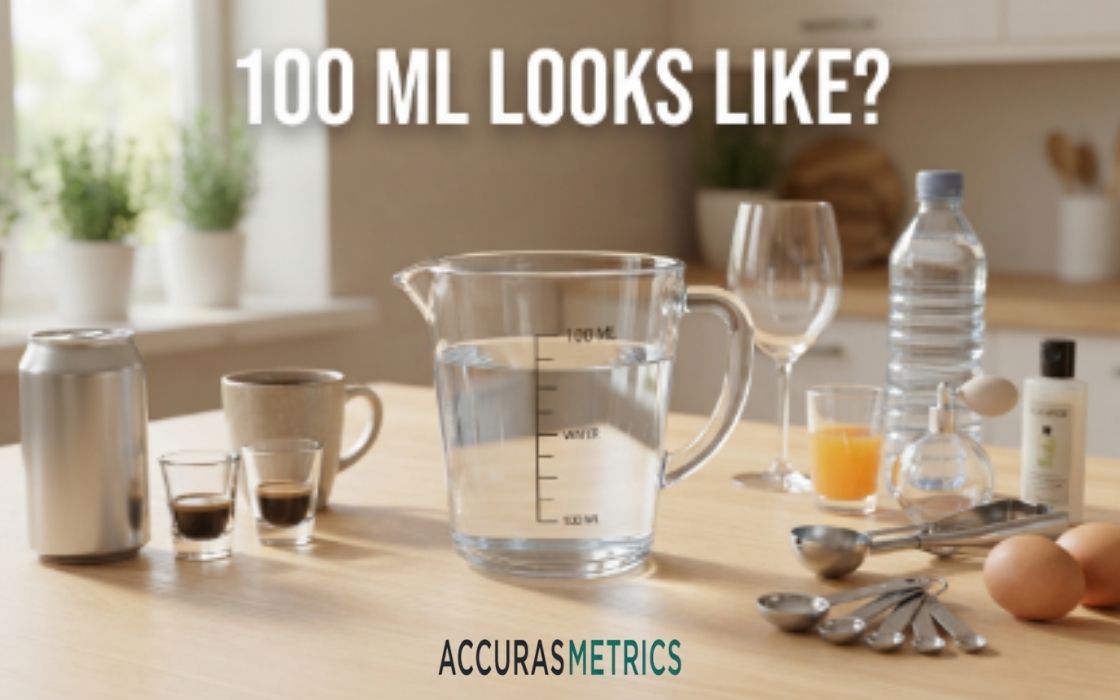
Picture a little less than half a measuring cup. That is 100 mL. It equals about 3.4 US fluid ounces, and you will see it on airport signs, recipes, nutrition labels, and product bottles.
But what does 100 mL look like in real life? Let us make it easy to picture with simple comparisons using kitchen items, drinkware, bottles, household objects, and everyday products.
What Exactly Is 100 mL?
| Unit | Amount in 100 mL |
|---|---|
| US customary cup | 0.42 cup |
| US tablespoon | 6.8 tbsp |
| Metric tablespoon | 6.7 tbsp |
| Australian tablespoon | 5 tbsp |
| US teaspoon | 20.3 tsp |
| US fluid ounce | 3.38 fl oz |
hundred milliliters is one tenth of a liter. It also equals hundred cubic centimeters. Imagine a cube about 4.6 cm (1.8 in) on each side. That’s the 100 ml volume in a nutshell.
In US units, hundred ml equals 3.38 fluid ounces. Imperial fluid ounces run slightly smaller, so the same amount equals 3.52 imperial ounces.
Here is the hundred ml equivalent across common kitchen measurements:
Why do the cup numbers differ? Because a US customary cup, a US legal cup, and a metric cup aren’t the same size. The metric cup holds 250 mL. The US legal cup holds 240 mL. Always check which system your recipe uses.
Kitchen Comparisons for 100 mL
Your kitchen holds the best measuring tools for building a mental picture. Start here.
Measuring Cup Reference

A standard measuring cup marks ⅓ cup at about 79 mL and ½ cup at about 118 mL. So 100 ml lands between the two lines. For a close match, pour ⅓ cup plus 1½ tablespoons. That gives you about 101 mL.
A liquid measuring cup works best here. It has a spout and extra headroom above the top line. Dry measuring cups are not built for pouring.
Tablespoons and Teaspoons

You will need about 6¾ US tablespoons or 20 teaspoons. Australian readers have it easier. Their tablespoon holds 20 mL, so five of them make 100 milliliters.
Quick tip: Use level spoons. A heaped tablespoon can hold 30% more than a leveled one.
Shot Glasses

A standard US shot glass holds 1.5 fluid ounces (44 mL). So 100 ml equals about 2¼ shots. However, shot glass size varies by country and bar. Some hold 25 mL. Others hold 60 mL. Treat them as a rough guide only.
A Can of Soda

A 12-ounce soda can holds 355 mL. Therefore, 100 ml equals a bit more than a quarter of the can. Pour out roughly three-quarters and you’ll see it.
Espresso Shots

A single espresso shot runs about 30 mL. A double runs about 60 mL. Three singles get you close to 100 ml. Lungo style drinks often land right around this coffee volume too.
Drinkware Comparisons for 100 mL
Now let’s grab a glass. These liquid measure comparisons help most at home.
Wine Glass

A standard US pour is 5 fluid ounces (148 mL). So 100 ml fills about two-thirds of that pour. A small UK pour is 125 mL. Tasting pours run 60 to 90 mL.
See what 80 feet looks like with everyday objects.
Coffee Mugs
Coffee mugs typically hold 240 to 350 mL. That means 100 ml fills roughly a third of the mug. Or it fills a bit less than half of a smaller one. Mug capacity varies a lot. Fill yours with a measured cup of water once and remember the line.
Here is how your morning brew stacks up:
| Mug Size | Portions of 100 mL |
|---|---|
| Small (240 mL) | 2.4 |
| Medium (300 mL) | 3 |
| Large (350 mL) | 3.5 |
Water Bottles

The 500 ml bottle is your built-in ruler. Divide it into five equal parts. Each part holds 100 ml. Water bottles in this size are everywhere. That makes bottle measurement easy anywhere.
For hydration context, the National Academies suggest about 2.7 liters of total water a day for women and 3.7 liters for men. That includes food. So 100 ml of water covers less than 4% of the daily target. A typical sip is about 20 to 30 mL.
Household and Travel Comparisons
Next, let’s look at everyday items beyond the kitchen.
Two Large Eggs

A large egg without its shell weighs about 50 g. It holds roughly 46 to 50 mL. So two eggs come close to 100 ml. Expect a range of about 90 to 100 mL. The USDA sets the egg size standards.
Travel Size Toiletries and the 100 mL Rule
This is the biggest reason people search this term. In the US, the TSA allows containers of 3.4 ounces (100 ml) or less. They must fit in one quart-size bag. The EU and UK use 100 ml containers in a 1-liter bag.
Keep these points in mind:
- The limit applies to container size. It doesn’t apply to how full the bottle is.
- A half-full 200 mL bottle usually won’t pass.
- Some airports with newer CT scanners have relaxed the limit. Rules vary by airport and country.
- Always check tsa.gov or your airline before you pack.
The TSA’s 3.4 oz figure rounds up from 3.38. So yes, the two numbers mean the same thing.
Read More our Article “11 Common Things That Are 3 Inches Long”
100 mL in Product Categories
Many products use this size as a standard. Here’s what to expect.
Perfume Bottles

100 ml perfume is a common large size. Standard perfume bottles come in 30, 50, and 100 mL. Each spray delivers roughly 0.07 to 0.1 mL. So a fragrance bottle this size holds about 1,000 sprays. Atomizers vary, so test your own bottle. That’s the best way to gauge fragrance volume.
Spirits, Wine, and Beer
Alcohol content changes what 100 ml means. Here’s the pure alcohol in each pour:
| Drink | ABV | Pure Alcohol in 100 mL |
|---|---|---|
| Spirits | 40% | 40 mL (about 32 g) |
| Wine | 12% | 12 mL |
| Beer | 5% | 5 mL |
A US standard drink contains 14 g of pure alcohol. So hundred mL of 40% spirits equals about 2.3 standard drinks. Learn more from the CDC or the NIAAA.
Does 100 mL Weigh 100 g?
Only for water. At 20°C, hundred ml of water weighs about 99.8 g. That makes water weight and water volume nearly a one-to-one match. Other liquids differ:
| Liquid | Approx. Weight of 100 mL |
|---|---|
| Water | 99.8 g |
| Milk | 103 g |
| Olive oil | 91 g |
| Honey | 140 g |
Oil floats on water because it’s lighter. Honey sinks because it’s denser.
How to Measure 100 mL Without a Measuring Cup
You don’t need special gear. These measuring methods work at home:
- Kitchen scale: Tare the container. Then add hundred g of water. Best for water-like liquids.
- Marked bottle: Fill a 500 mL bottle one-fifth of the way.
- Spoons: Use 6 level US tablespoons plus 2 level teaspoons. That gives about 99 mL.
- Oral syringe: Great for small amounts. A hundred mL syringe exists too.
Digital scales beat the printed lines on most cups for consistency. Analog tools like cups are fine for cooking. Lab glassware beats both when precision counts. Choose the tool that fits the job.
See our guide to Red Bull can dimensions for more size comparisons.
Quick Conversion Cheat Sheet
Save this table for later. It covers 100 ml measurement and nearby sizes.
| Milliliters | US Fl Oz | US Cups | US Tbsp | Water Weight |
|---|---|---|---|---|
| 50 mL | 1.7 | 0.21 | 3.4 | 50 g |
| 100 mL | 3.4 | 0.42 | 6.8 | 100 g |
| 200 mL | 6.8 | 0.85 | 13.5 | 200 g |
| 250 mL | 8.5 | 1.06 | 16.9 | 250 g |
| 500 mL | 16.9 | 2.11 | 33.8 | 500 g |
Why Is 100 ML Important?
100 ML may seem like a small amount, but it is a useful volume in many everyday situations. You may come across it when following recipes, measuring drinks, packing travel liquids, or working with household products.
In cooking, 100 ML can help you measure milk, water, oil, and other ingredients. It is also a familiar size for small bottles, perfume, shampoo, and some beverages. Knowing what hundred ML looks like makes it easier to estimate liquid amounts when you do not have a measuring cup nearby.
For another measurement comparison, see our guide to 4 inches.
Case Study: How One Traveler Mastered 100 mL Before a Flight
Note: This is an illustrative scenario built from real rules and conversion figures. It isn’t a documented account of a real person.
The Problem
Maya owns a 250 mL shampoo bottle that’s half full. Figuring it holds about 125 mL of liquid, she assumes it’s close enough to the limit. Unfortunately, she is wrong.
The TSA limit applies to container size. It does not apply to how much liquid sits inside. A 250 mL bottle fails the 100 ml rule even when it’s nearly empty. Security would toss it.
The Fix
Maya decides to transfer her products into travel bottles. But she has no idea how to measure 100 ml without guessing. So she tests three measuring methods at home.
| Method | How She Did It | Result |
|---|---|---|
| Measuring cup | Poured ⅓ cup plus 1½ tablespoons | About 101 mL |
| Digital scales | Tared the bottle and added 100 g of water | 100 mL (99.8 g at 20°C) |
| 500 ml bottle | Filled one-fifth of the bottle | About hundred mL |
The scale gave her the most consistent result. The measuring cup came in a close second. The bottle method worked best as a quick check.
What She Learned
Three lessons stood out:
- Container size matters. Every bottle in her bag must hold 3.4 oz (hundred mL) or less.
- Water is a special case. hundred ml of water weighs about 100 g. Honey weighs about 140 g for the same volume, so the scale trick only works for water like liquids.
- Rules vary. Some airports with newer CT scanners have relaxed the limit. Maya checked her airport and airline before she packed.
She also remembered the quart-size bag rule in the US. In the EU and UK, the same 100 ml bottles go in a 1-liter bag.
The Outcome
Maya filled four 100 mL bottles, and each one fit in her clear bag. She cleared security without a second look. Better yet, she now knows what hundred milliliters looks like: a little less than half a cup.
Key Takeaway
Small volumes cause big headaches when you guess. A quick test with a measuring cup, a scale, or a 500 ml bottle takes two minutes. It can save you a lost toiletry and a stressful moment at the checkpoint.
Read more our article How Big Is a Football Field?
FAQs About 100 mL
Got questions about 100 ml? These quick answers cover the ones people ask most. Each answer leads with the number, so you can grab it and go.
How much is 100 mL in cups?
About 0.42 US cup. That’s a little less than half a cup. It’s also about 0.4 of a metric cup.
How many ounces is 100 mL?
100 ml equals 3.38 US fluid ounces. Airlines round it to 3.4 oz.
How many tablespoons is 100 mL?
About 6.8 US tablespoons. Australians use five of their larger 20 mL tablespoons.
How many grams is 100 mL of water?
About hundred g. At 20°C it’s 99.8 g. Other liquids weigh more or less.
Is 100 mL the same as 3.4 oz for TSA?
Yes. The TSA rounds up from 3.38 oz. The rule applies to the container size.
See how big 2 inches really is.
Conclusion: See 100 mL Anywhere
Now you have several simple ways to picture 100 mL without reaching for a measuring cup. The easiest ones to remember are:
- Just under half a US cup
- A little more than one-quarter of a 12-ounce soda can
- One-fifth of a 500 mL water bottle
You can also think of hundred mL as about 3.4 US fluid ounces or roughly 100 g of water.
Next time you see 100 mL on a bottle, recipe, nutrition label, or travel container, you will have a much better idea of how much it actually is. Keep the conversion chart above handy whenever you need a quick liquid measurement.

Alison David is a dedicated contributor at Accuras Metrics, managing the Measurements category with a passion for accuracy and clarity. She creates informative content that helps readers understand measurements, units, and practical comparisons through simple explanations and reliable insights.