
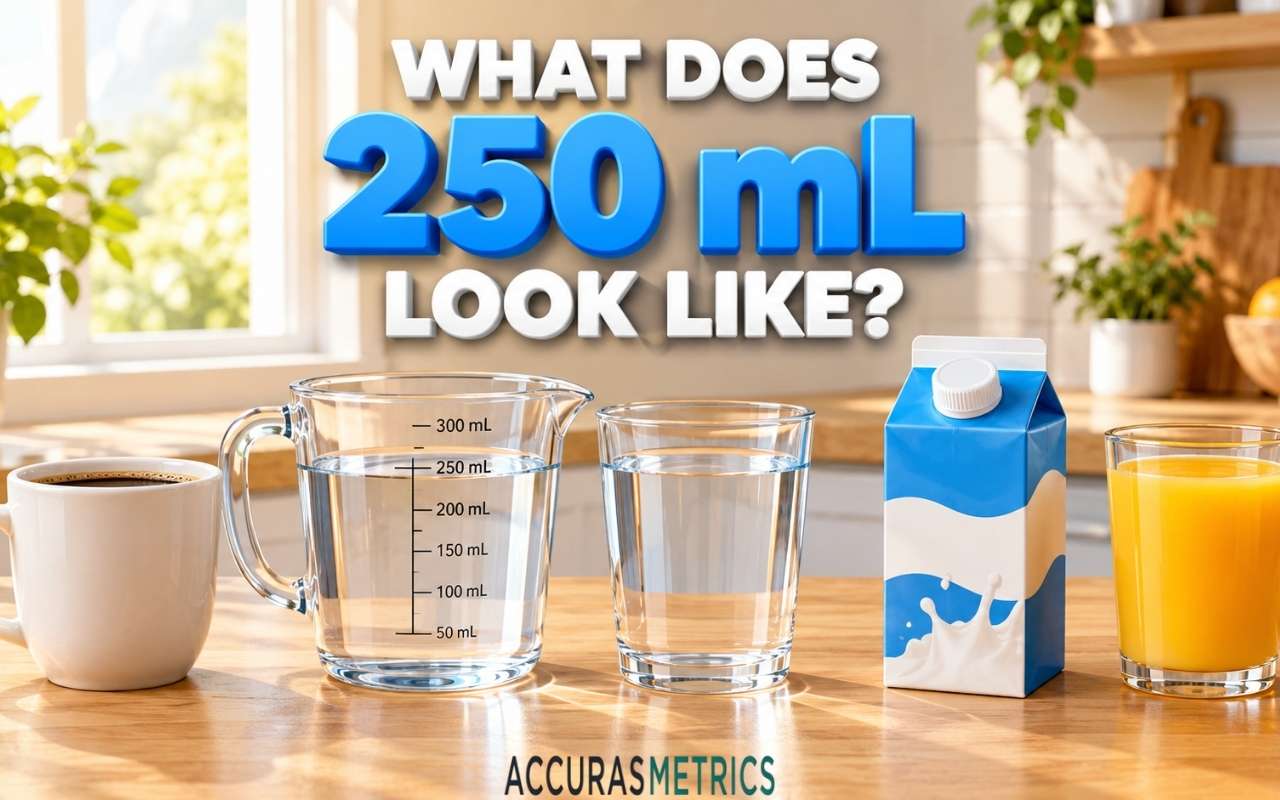
Have you ever wondered what 250 mL of liquid looks like in everyday life? You may see this measurement on water bottles, milk cartons, or cooking recipes, but picturing the amount can be tricky without a measuring cup.
From drinking glasses to coffee mugs, familiar household items can help you visualize this volume. It equals a quarter-liter or approximately 8.45 US fluid ounces.
Explore these eight everyday examples to see how this amount compares with common containers and measurements.
What Does 250 mL Look Like?
A quarter-liter of water can fit into many everyday drinking containers, depending on their capacity. In a smaller glass, it may reach close to the rim, while a larger one will leave some space at the top.
Container shape also affects how liquid looks. A wide glass makes the same amount appear shallower, while a narrow glass makes it look taller. For a reliable estimate, consider the container’s capacity rather than its appearance alone.
Here are some quick facts about 250 mL and its equivalent measurements:
| Measurement | Equivalent |
|---|---|
| Volume in liters | 0.25 liters |
| Volume in US fluid ounces | Approximately 8.45 fl oz |
| Volume in cubic centimeters | 250 cm³ |
| Metric cup measurement | One metric cup |
| Weight of water | Approximately 250 grams |
The weight comparison applies to water under ordinary conditions. Milk, oil, juice, and other liquids may weigh slightly more or less because their densities differ.
8 Everyday Examples That Show What 250 mL Looks Like
The following eight examples provide practical ways to visualize this size. Some are designed to hold exactly this amount, while others are useful comparisons because their capacities are close to or greater than 250 mL.
1. A Metric Measuring Cup

A metric measuring cup with clear measurement markings is one of the most accurate ways to picture this volume. When you pour water up to the 250 mL line, you can see exactly how much space the liquid occupies.
Many measuring cups include markings for 50, 100, 150, 200, and 250 mL. These lines make it easier to measure ingredients for cooking, baking, and preparing drinks.
If your measuring cup has a 250 mL mark, fill it to that line rather than to the rim. The space above the liquid helps prevent spills when you move the cup.
Why it helps: This example provides a direct visual reference without relying on estimates. It is especially useful when accuracy matters.
2. A Small Drinking Glass

A small drinking glass is another familiar way to imagine this size. Some glasses have a capacity close to 250 mL, so this amount of water may fill one almost to the top.
However, drinking glasses come in many sizes. A compact glass might hold around 200 to 250 mL, while a larger glass may hold 300 to 400 mL or more.
For example, if your glass has a capacity of 300 mL, pouring in this amount will leave some space at the top. If the glass holds exactly 250 milliliters, the liquid will reach its full capacity.
You can check the glass’s capacity by measuring the amount of water it holds with a graduated measuring jug.
Why it helps: Most homes have drinking glasses, making this an easy everyday comparison for visualizing a quarter-liter of water.
3. A 250 mL Water Bottle

A small water bottle labeled 250 mL provides one of the simplest examples of this measurement. The label tells you the bottle’s stated liquid capacity, so you do not have to estimate how much it holds.
These small bottles are useful for carrying a modest amount of water, serving drinks, or packing beverages for short outings. Their shape can vary, with some bottles being short and wide and others tall and narrow.
Remember that the amount of space the water occupies depends on the bottle’s shape. A tall, narrow bottle makes the water level appear higher than it would in a short, wide bottle containing the same amount.
A 250 mL bottle is also a convenient reference when comparing liquid quantities in recipes or daily measurements.
Why it helps: The capacity is printed on the packaging, making this a reliable reference when the bottle is clearly labeled.
4. A Cup of Milk

A metric cup of milk contains one cupful when the recipe follows the metric cup standard. This makes milk a useful everyday example for understanding liquid measurements in cooking.
You might use this amount when preparing oatmeal, mixing pancake batter, making a sauce, or adding milk to tea and coffee. Pouring two hundred and fifty milliliters of milk into a transparent measuring jug lets you see the volume clearly.
A regular household cup is not always a metric cup. Some cups hold around 240 mL, while others hold 300 mL or more. Therefore, using an ordinary cup without checking its capacity may give you a slightly different amount.
Milk is slightly denser than water, so an equal volume of milk generally weighs a little more. For example, two hundred and fifty milliliters of milk typically weighs slightly more than the same volume of water, depending on its fat content and composition.
Why it helps: Milk is a common kitchen ingredient, and a 250 mL portion is easy to understand when following recipes.
5. A Glass of Juice

A glass of juice can help you visualize a typical serving at breakfast or during a snack. If your glass has a capacity of one metric cup, the liquid will fill it to its intended capacity.
Larger juice glasses may hold 300 to 350 milliliters or more. In these containers, the same serving will leave some empty space above the liquid.
For a simple comparison, pour 250 mL of juice into a measuring jug first. Then transfer it to your usual juice glass and observe the level. You can remember that level for future reference.
The same idea works with orange juice, apple juice, lemonade, and other beverages. Their colors differ, but their volume remains 250 mL when measured accurately.
Why it helps: A familiar serving of juice gives you a practical visual reference for drinks served at home.
6. A Regular Coffee Mug

A coffee mug is a useful everyday comparison, although many mugs hold considerably more than a quarter of a liter. Smaller mugs may hold around 250 milliliters, while larger ones often have capacities of 350 to 450 milliliters or more.
Suppose your mug holds 350 mL when full. Pouring in 250 mL would fill roughly 71% of its total capacity, leaving space at the top. In a mug with a 300 mL capacity, the same amount would fill about five-sixths of the container.
The exact water level depends on the mug’s shape. A mug that widens toward the top will show a different fill height from a straight-sided mug.
You can use a measuring jug to check your favorite mug once. After that, you will have a much better idea of how 250 mL looks in your own kitchen.
Why it helps: A coffee mug is easy to find at home, and comparing it with a measured amount can improve your ability to estimate liquid volumes.
7. A Small Soup Bowl

A small soup bowl can also help you visualize 250 mL, particularly if you regularly serve soup, broth, or other liquid foods.
Unlike a measuring cup, a soup bowl usually does not have volume markings. Its capacity depends on its diameter, depth, and shape. A small bowl may hold 300 to 400 mL, while a deeper bowl may hold considerably more.
If you pour 250 mL of soup into a bowl with a 350 mL capacity, the liquid will occupy about 71% of its total capacity. However, this percentage does not mean the soup will reach 71% of the bowl’s height because the bowl may widen toward the top.
For the clearest comparison, measure 250 mL of water and pour it into the bowl. This shows how much space that amount occupies before you use the bowl for food.
Why it helps: A soup bowl shows how the same liquid volume can look different in a wide container compared with a narrow glass.
Explore the Statue of Liberty dimensions to discover its height and size in detail.
8. A Small Beverage Carton

A beverage carton labeled 250 mL is another direct example. Small cartons of milk, juice, and other drinks are commonly sold in this size, although availability depends on the product and market.
The volume printed on a beverage carton indicates the amount of liquid it is designed to contain. The packaging may include a folded top or extra space, so its external dimensions do not directly reflect the liquid capacity.
Small beverage cartons are useful for comparing packaged drinks. For example, two cartons labeled 250 milliliters contain 500 milliliters altogether, provided each contains its stated quantity.
Always check the printed volume rather than judging a carton by its height or width. Different packaging designs can hold the same amount of liquid.
Why it helps: The printed label offers a straightforward way to recognize 250 mL when shopping for milk, juice, or other packaged drinks.
How Much Is 250 mL Compared to Common Measurements?
Understanding common conversions makes it easier to visualize 250 mL even when a measuring cup is unavailable.
| Measurement | Equivalent to 250 mL |
|---|---|
| Liters | 0.25 L |
| US fluid ounces | Approximately 8.45 fl oz |
| US customary cups | Approximately 1.06 cups |
| Metric cups | 1 cup |
| Cubic centimeters | 250 cm³ |
| Cubic meters | 0.00025 m³ |
These conversions refer to liquid volume. The US cup and metric cup are not identical, so it is important to use the correct standard when following a recipe.
250 mL Compared to 1 Liter

One liter contains 1,000 mL. Therefore, 250 mL is exactly one-quarter of a liter.
Imagine a one-liter bottle of water divided into four equal portions. Each portion would contain 250 mL. This is a simple way to understand the measurement without needing to picture a separate container.
250 mL Compared to a US Cup

A US customary cup holds approximately 236.6 mL. Therefore, 250 mL is slightly more than one US cup.
The difference is about 13.4 mL. This may be small for many everyday drinks, but it can matter when precision is important in baking or cooking.
A metric cup, by comparison, is commonly defined as exactly 250 mL.
250 mL Compared to 8 US Fluid Ounces

Eight US fluid ounces equal approximately 236.6 mL, which is slightly less than 250 mL. A quarter-liter contains approximately 8.45 US fluid ounces.
This difference is worth remembering when reading recipes that use both metric and US customary measurements.
See our guide on how long 30 inches is
How Can You Measure 250 mL Without a Measuring Cup?
If you do not have a measuring cup, you can still estimate 250 mL using familiar containers. However, the accuracy depends on knowing the container’s capacity.
Here are three practical methods:
- Use a labeled bottle: Pour the contents of a 250 mL bottle into your glass to see the corresponding fill level.
- Check a beverage carton: A carton labeled 250 mL provides a useful reference for the amount it contains.
- Use a kitchen scale: If you are measuring water, 250 grams is approximately 250 mL under ordinary conditions. Place a suitable container on the scale, tare it to zero, and add 250 grams of water.
Avoid assuming that every drinking glass or coffee mug holds 250 mL. Their capacities vary, and visual estimates may be inaccurate.
For baking, precise recipes, or any situation where the quantity matters, a graduated measuring jug is the better choice.
Related read: What Does 100 mL Look Like? Everyday Comparisons
Frequently Asked Questions
Find quick answers to common questions about this measurement.
Is 250 mL the Same as One Cup?
It depends on the cup measurement system. A metric cup holds exactly 250 milliliters, while a US customary cup holds approximately 236.6 milliliters. Always check which measurement standard your recipe uses to ensure accurate results.
Is 250 mL a Lot of Water?
250 mL is a quarter-liter of water. It is a modest amount compared with a one-liter bottle, which holds four times as much. Whether it is enough to drink depends on your circumstances and overall fluid needs.
How Many Ounces Are in 250 mL?
250 mL equals approximately 8.45 US fluid ounces. This is a little more than 8 US fluid ounces.
Does 250 mL Fill a Regular Glass?
It can fill a small glass, but the result depends on the glass’s capacity. A 250 mL glass will hold that amount when filled to its intended capacity, while a larger glass will leave some space at the top.
How Much Does 250 mL of Water Weigh?
A 250-milliliter serving of water weighs approximately 250 grams under ordinary conditions. Other liquids, such as milk and cooking oil, have different densities, so the same volume can weigh slightly more or less depending on the liquid.
See what 80 feet looks like with everyday objects.
Final Thoughts on What 250 mL Looks Like
So, what does this amount look like? It is a quarter-liter of liquid, equal to approximately 8.45 US fluid ounces or one metric cup.
A measuring cup, small drinking glass, water bottle, milk carton, or juice glass can help you visualize this quantity. Coffee mugs and soup bowls offer additional comparisons, although their capacities can vary considerably.
The key is to remember that 250 mL is a fixed volume, but its appearance changes with the container’s size and shape. For accurate results, use a graduated measuring jug or a container with clear markings. Everyday comparisons help you estimate the amount, while proper measuring tools ensure precision.
See our guide to Red Bull can dimensions for more size comparisons.
Quick Quiz: Test Your Knowledge
Test your knowledge with this short quiz about everyday liquid measurements. Answer three quick questions to see what you’ve learned.
1. How many liters are equal to 250 mL?
A) 0.5 liters B) 0.25 liters C) 1 liter D) 2.5 liters
Answer: B) 0.25 liters
2. Approximately how many US fluid ounces are in 250 mL?
A) 4.5 fluid ounces B) 6 fluid ounces C) 8.45 fluid ounces D) 12 fluid ounces
Answer: C) 8.45 fluid ounces
3. Which tool is best for measuring an exact amount of liquid?
A) Soup bowl B) Coffee mug C) Drinking glass D) Graduated measuring cup
Answer: D) Graduated measuring cup
For another measurement comparison, see our guide to 4 inches.

Alison David is a dedicated contributor at Accuras Metrics, managing the Measurements category with a passion for accuracy and clarity. She creates informative content that helps readers understand measurements, units, and practical comparisons through simple explanations and reliable insights.